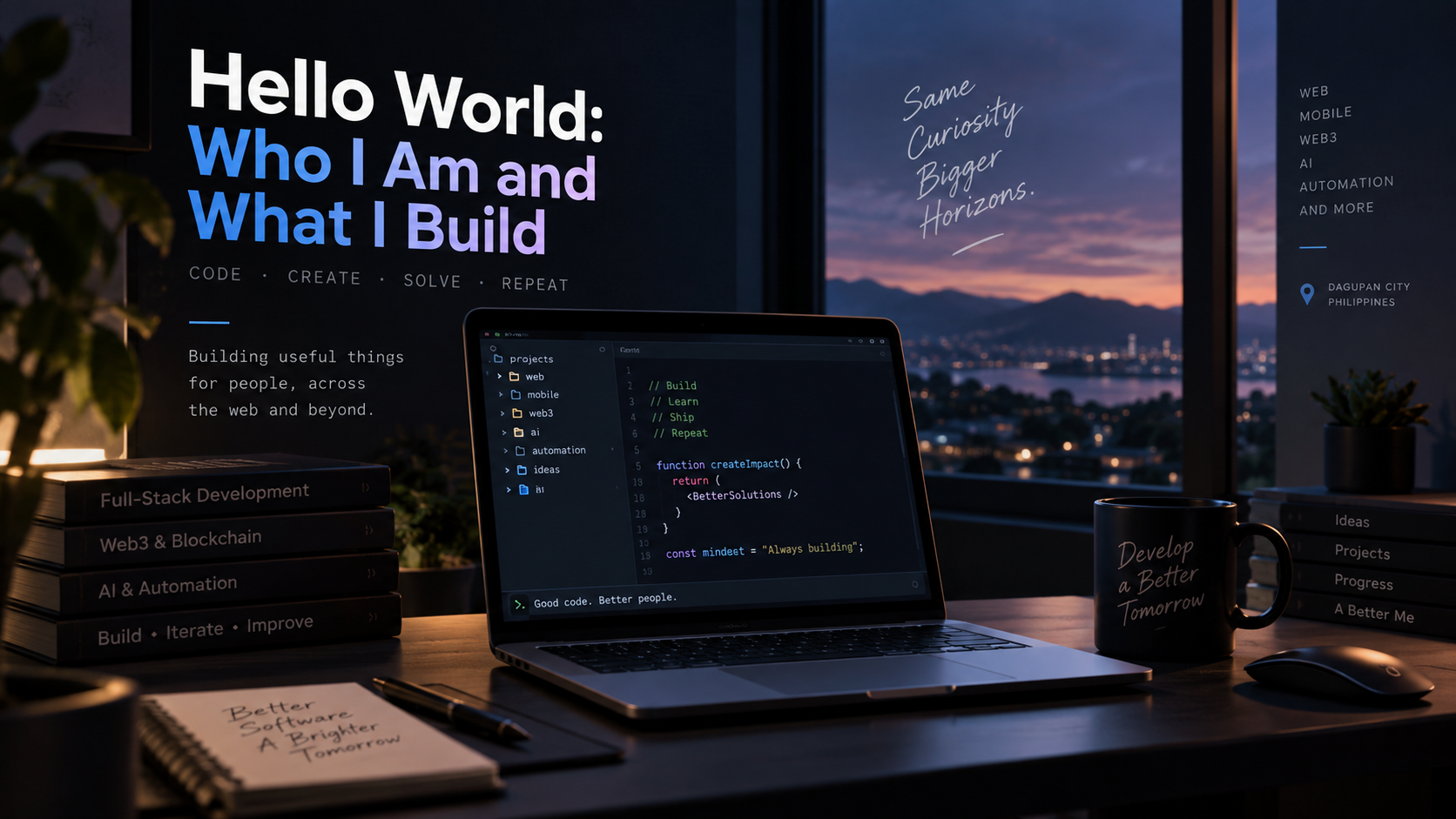
Hi, I'm Dalrymple Ramos. I am a full-stack developer based in Dagupan City, Philippines.
I graduated with a Bachelor of Science in Information Technology from PHINMA University of Pangasinan. After an engineering internship, I moved into full-time development. Today, my work spans the full development lifecycle, from understanding a problem and shaping a solution to building, integrating, and improving the software behind it.
I write code to solve structural problems. Whether that means bringing a complex application together, building an augmented reality learning experience, or working with decentralized systems, my goal is to create software that is robust, useful, and centered on the people who rely on it.
Here is a look at how I work, the kinds of problems I take on, and the philosophy behind what I build.
Engineering Beyond the Stack
If there is a core principle to my work, it is that I do not view myself as just a React developer, a Node engineer, or a Web3 specialist. Frameworks have lifespans; engineering principles do not.
My primary competency is adaptability. I view programming languages and libraries as tools rather than strict boundaries. Whether an architecture calls for something I have used for years or something I need to learn for the problem in front of me, the underlying concepts of state, security, and scalability still matter. I focus on understanding the constraints, then choosing an approach that fits.
Working Across the Full Stack
My work spans the full stack and the full development lifecycle. I can move between the parts of a product, from shaping an interface and organizing its data to connecting services, building backend systems, and refining how everything works together.
The problems vary. I might be building a business application, a content platform, an internal tool, a dashboard, an online store, or a custom website. I also work on the systems behind those experiences, including APIs and automation. The form changes with the need; my focus stays on making the whole solution work well for the people using it.
AI tools have also become part of my development workflow. I use them to explore ideas, move through routine work more efficiently, and support my productivity. They are useful tools in the process, while the responsibility for understanding the problem and making sound engineering decisions stays with me.
Building Across Different Environments
My work is not limited to one platform or category. I can build across mobile, the web, and Web3, as well as work with AI and automation when they fit the problem. Each environment brings different constraints, and I adapt how I approach the work to meet them.
There is always more to learn and build. I focus on understanding what a system needs to do, then adapting my approach and choosing tools to fit, whether the work involves familiar technologies or a new environment.
The Discipline of Continuous Iteration
If you look past the major deployments, my GitHub history is a record of constant experimentation. The reality of software engineering is that you improve by building, breaking things, and figuring out how to put them back together.
Behind every polished application are dozens of other projects, repositories, and late-night experiments. Sometimes I build a productivity tool simply to remove a minor friction point in my own daily workflow. Other times, I explore a different kind of application or a new way of structuring a system to understand where it works well and where it falls short.
Every side project, regardless of its scale, serves as a sandbox for failing fast, refining architecture, and ultimately, becoming a more resilient engineer. It is this habit of continuous iteration that bridges the gap between knowing how to write syntax and knowing how to build actual software.
The Bottom Line
Whether I am building a straightforward management platform, an experimental mobile app, or a complex Web3 ecosystem, my approach remains the same: I write clean, maintainable code; I choose the right tool for the specific constraint; and I build systems designed to scale.
If you want to look at the code behind the systems, you can find my open-source work and project repositories on GitHub under ramosdalrymple-afk. For direct inquiries, I can be reached at ramosdalrymple@gmail.com.