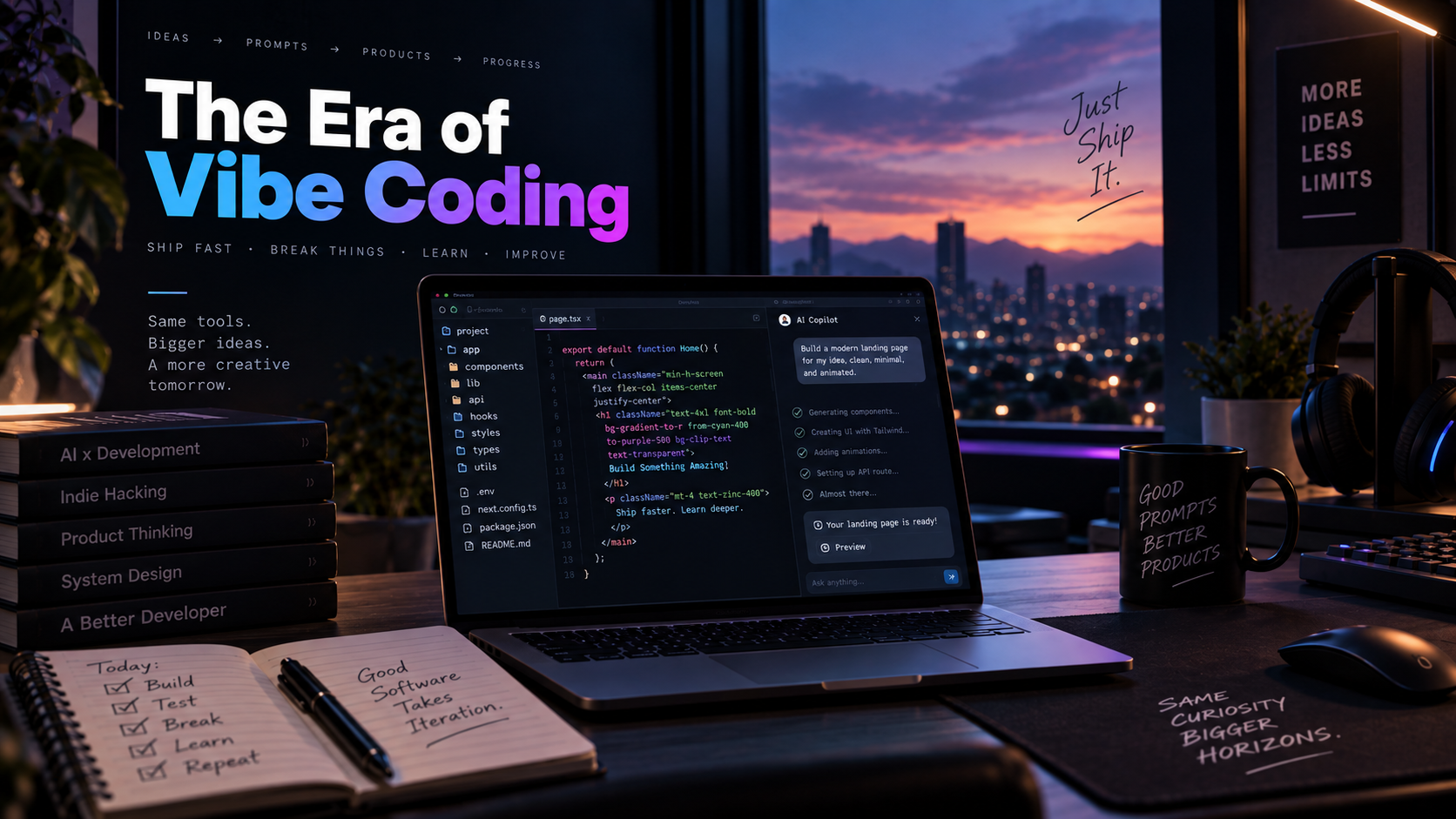
We have crossed a threshold in software development where syntax is no longer the primary bottleneck. If you can articulate a problem clearly, you can probably generate the code to solve it.
This is the era of "vibe coding"—a paradigm where developers spend less time agonizing over missing semicolons and more time steering AI agents through natural language prompts. You focus on the architecture, the user experience, and the overall "vibe" of the application, while the AI hammers out the boilerplate.
For the modern indie hacker, it feels like a superpower. But like any powerful abstraction, vibe coding comes with a hidden cost. If you rely on it completely, you risk becoming an operator of a black box rather than an engineer of a system.
Shipping at the Speed of Thought
Let’s be clear: the strengths of vibe coding are undeniable. It is the ultimate manifestation of the 80/20 rule.
When you want to spin up a new dashboard, you don't need to manually type out every UI component or wrestle with the initial CSS grid. You prompt your way to a functional layout, wire up a quick API route, and suddenly you have a working prototype in an afternoon. Vibe coding allows you to stay in a state of high-level flow. It eliminates the mundane friction of scaffolding, letting you focus entirely on the product's core value proposition.
For side projects and weekend experiments, this velocity is everything. It allows you to test an idea, build out a feature, and deploy it to the world before the initial spark of inspiration fades. You are no longer constrained by the speed at which you can type; you are only constrained by the clarity of your instructions.
The MVP Illusion
Vibe coding gets you from zero to one with terrifying speed. But it also creates the "MVP Illusion."
You prompt a beautifully structured landing page and a seemingly functional auth flow, and you feel like the project is 90% done. In reality, you have only completed the easiest 20%. The final 80% of the effort—the edge cases, the performance optimization, the security logic—cannot be vibed into existence.
When you are building applications that handle real value, like decentralized rights models or micro-financing platforms, a hallucinated line of logic isn't just a UI bug; it is a critical vulnerability. The AI doesn't know the business logic constraints of your specific smart contract architecture or the nuanced rules of your database schema. It only knows patterns. If you rely on it to build the core engine of your product without verifying the mechanics, you are building a house of cards.
The Hallucination Trap
The danger of vibe coding isn't that AI will take your job. The danger is that it will slowly erode your fundamental understanding of the systems you are building.
The illusion of mastery is incredibly potent when an AI is writing 90% of your logic. It feels amazing right up until the moment your server actions start throwing cryptic hydration errors, or your database requires a complex data migration that the AI simply cannot conceptualize across multiple interconnected tables.
When the "vibes" run out, and the AI generates a beautifully formatted, completely hallucinated interface, what do you do?
If you have spent all your time prompting and none of your time debugging, you hit a brick wall. This is where the difference between an operator and an engineer becomes painfully obvious. An operator stares at the error, tries five different prompt variations, and eventually gives up. An engineer rolls up their sleeves, reads the stack trace, and fixes the underlying flaw.
Architecture Over Autopilot
Vibe coding should be a tool in your belt, not a replacement for your brain.
To survive in a landscape where code generation is ubiquitous, your value is no longer tied to how fast you can write boilerplate. Your value is in your ability to architect scalable systems, secure your data, and optimize performance. AI can write a brilliant standalone function, but it currently lacks the holistic context to understand how that function impacts your entire decentralized state or your cross-platform mobile architecture.
You have to maintain the discipline of knowing what the AI is actually doing under the hood. If you prompt it to build an intricate animation or a complex query, take five minutes to read the code it generated. Understand the hooks. Understand the rendering cycle.
Rules of Engagement for the Vibe Coder
If you want to leverage AI without losing your edge, you need rules of engagement:
- Design the Architecture First: Do not let the AI decide your tech stack or your database schema. You dictate the rules, the data flow, and the state management. Let the AI fill in the blanks within the boundaries you set.
- Read Before You Run: Never blindly copy-paste. If you don't understand why the AI chose a specific method, ask it to explain, or go read the documentation yourself.
- Commit in Atomic Chunks: When vibe coding, it is easy to let the AI rewrite 500 lines of code at once. Don't. Force it to build incrementally, and commit those changes to your repository frequently so you have a safe fallback when it inevitably hallucinates a breaking change.
Embrace the Abstraction, Keep the Discipline
The tech industry's ground is shifting again, and fighting the integration of AI into your workflow is a losing battle.
Embrace vibe coding to escape tutorial purgatory. Use it to ship your MVPs faster, to draft your initial components, and to automate your tedious tasks. Let it handle the scaffolding so you can focus on the logic.
Just remember that you are still the pilot. The AI is a fantastic co-pilot, but when you hit turbulence, you need to know how to fly the plane manually. Keep building, keep breaking things, and never let the convenience of a generated solution stop you from understanding how it actually works.